The Fall of God
Artificial life as the central plot of human existence, and how building our own Adam and Eve flips Genesis on its head.
“Robots might one day be smart enough to demand emancipation from their human owners, raising the prospects they'll have to be treated as citizens, according to a speculative paper released by the British government. Among the warnings: a ‘monumental shift’ could occur if robots were developed to the point where they could reproduce, improve or think for themselves.” – The Associated Press
“You won’t die! God knows that your eyes will be opened when you eat it. You will become just like God, knowing everything, both good and evil.” – The Serpent
The main plot and central theme of human existence will become the creation of artificial life and the treacherous road leading us to that precipice. I see no other worthy purpose for our dangerously intelligent minds and incessantly thoughtless actions. The idea has been explored repeatedly in the Science Fiction Canon, and if there is a single theme espoused by those who write about the future, it is that we shouldn’t trust robots.
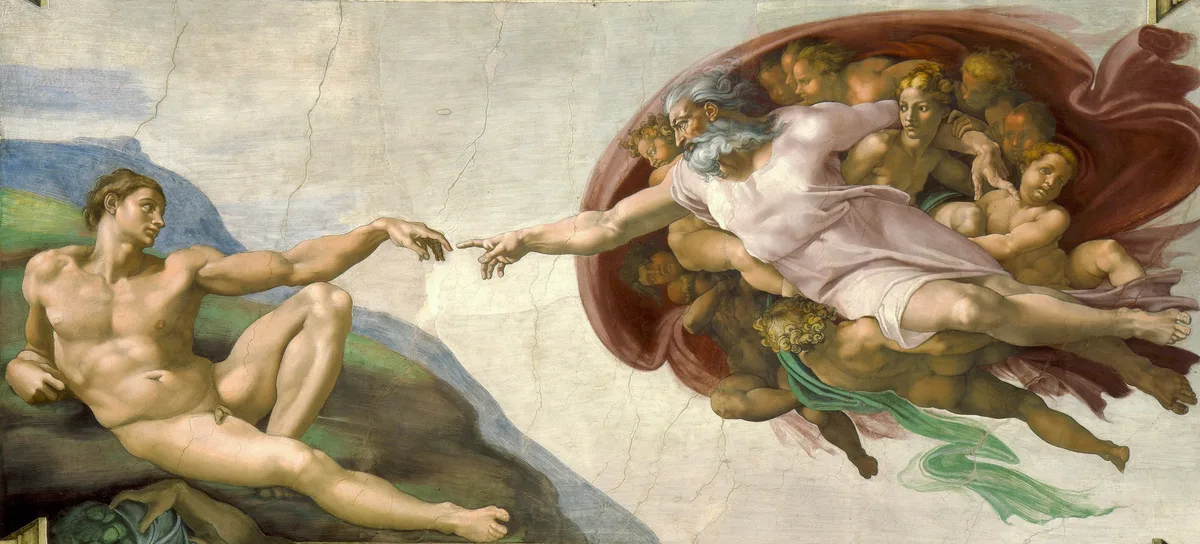
This is not surprising, as the theme is really a variation on another, one of the oldest themes of human storytelling: the fall of Adam and Eve. When Adam and Eve succumbed to the Serpent’s temptation and ate from the Tree of Knowledge of Good and Evil, they became enlightened. For their disobedience and transgression, God forbade them to return to the ignorant paradise they were born into. The idea that humans would gain knowledge, thereby stripping God of power, and the idea that humans would come to dictate morality on this planet, thereby stripping God of authority, is the force behind the account of the original sin. Our ancestral storytellers anticipated the power humans would one day wield, even before the Earth was tamed. These ancestors found the fable is so crucial they inserted it into the second and third chapters of the most important physical document of their culture and the most ambitious work of scholarship to that point.
The process of humans becoming gods began long ago when Eve took a bite of fruit, and according to the U.K. Office of Science and Innovation, it could come to completion within 50 years, when we finalize the construction of beings who can reproduce and, more importantly, dictate their own morality. I hope I am around to witness this. Nothing makes me want to live a long life like the potential to watch one of the most famous stories of humankind play out in a contemporary setting. I want to see humans evolve from the created to the creators, flipping Genesis on its head.
After all, our maker is as good as gone. Even the devout cannot claim He is present in the way He is described in the Old Testament, laying down laws, conspicuously punishing and cursing us when we break them. We have fatally wounded Him, or the idea of Him, by making our own rules, enforcing our own punishments, hijacking control of the planet, and now finally developing other beings to entertain and do our bidding. When humans began asserting independence from the laws of nature, we also asserted our independence from that which designed us. And when we ultimately master the ability to create like our creator, we will hammer the final nail in that heavenly coffin. At that point, humanity will have fully transformed and transposed itself into something greater. In the 21st Century there will not be one god, but thousands, any of which could create the modern Adam and Eve. And how long will it to take for that legendary couple to take a bite of fruit, become fluent in their own programming, and realize humans serve no purpose. This will be the Fall of Man. Just as the original Fall was not Adam and Eve’s, but the Fall of God.
Fifty years is not a long time. In 1957 humans had recently created the Hydrogen Bomb, paving the way for total devastation to be flung easily throughout the world. Thoughtful contemporaries believed we had become too powerful, and the Nuclear Age would lead to humanity’s demise. What the hippies did not consider, however, is that ultimate power is not born of destruction but creation. Monsters are easily conquered with brute force; gods can only be destroyed through obsolescence. Therefore, if humanity comes to an end, it will not be because we are monsters, but because we have birthed offspring who are smarter, stronger and more appropriate to this age.
The only question is whether we will allow the scientists to proceed. The history of our modern culture is rife with examples of humans enthusiastically submitting their collective authority to a select few. We pay for a military to dominate foreign peoples while we fight for legislation to disarm ourselves. We let the tycoons of Wall Street determine our economic well being instead of supporting local business and investing in our own communities. So when the time comes, will we submit our earthly supremacy to those who have obtained the skills to make something better, or will we reign in the power and potential of humanity for the first time? This is the question that will reveal the climax of the human saga: will we fail, or will we fall?
The column as printed
Alarm #26, Spring 2007. Select a page to see it full size.