Johnny Cash's "Spiritual," scarcity, and a future where entire lives are recorded, priced, and relived.
Read essay ↓
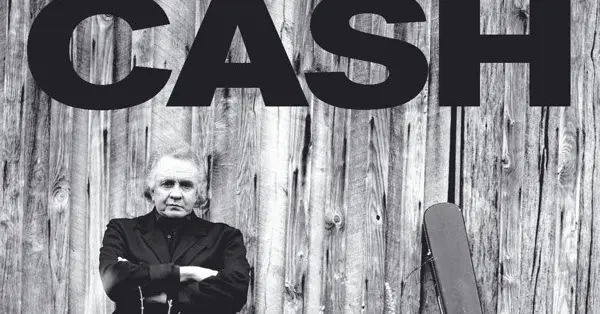
Five years ago I worked cooking Mexican food in the kitchen of a tiny restaurant in upstate New York. The boss had good taste in music, so the small overlap between what she liked and what was appropriate induced a lot of Johnny Cash - mainly the American Recordings series. Unchained is the least spectacular of those albums, but “Spiritual,” about midway through, shook me fiercely...often. I took in every expiration and imagined myself next to that great American as he sang out to his God, immersed in perfect loneliness, praying for comfort.
I am not Christian. I’ve read the Bible, so I’m sure. The book, especially in modern translation without the stylistic frills and convenient inaccuracies of the King James, is at worst offensive and at best absurd. Still, when that song came on, I was able to pretend I could feel what he felt, because I couldn't shake that Christian performance and the feeling of those special few seconds when he sings/cries for the final time, “All my troubles...all my pain.” It's overwhelming. I don't think Cash ever got to those notes again, and I think about Rick Rubin, the Heartbreakers, some engineer, whoever else was in that room when he did that. I think about how fortunate those people were to have been a part of it. How valuable the experience was, because there was only one occurrence of that incredible moment in our history, and it will never happen again.
The reason our lives have value is because those moments happen. The first thing people learn about economics is the correct price of any commodity lies at the intersection of the supply and demand curves. As either demand increases or supply decreases, value goes up.
We are witness to special things, singular things. Because we want them and because of their ultimate exclusivity, they are supremely valuable. However, because those moments are valuable, buyers and sellers will attempt to put a number on that value. We know exactly how to price Johnny Cash's Unchained CD ($14.50 on Amazon) or the “Spiritual” mp3 (99¢ on iTunes), but the experience of watching Johnny Cash create that moment, which because of a bout of pneumonia and subsequent lung damage he would never be able to re-create, is currently elusive to the marketplace. But this will change.
Earlier this year, The Beatles: Rock Band was released. According to the sellers, “you won't just watch and listen as The Beatles make rock history, create landmark records, and conquer the world – for the first time, you’ll be part of the band!” The Beatles' complete experience, previously limited to the minds and memories of those who lived it, is now for sale. Yes, this is a video game in which a cartoon version of one of the Fab Four acts out what you play on a plastic instrument. Yes I'm being hyperbolic, but only because this is the limit of what technology has to offer in 2009.
More and more of our world is being captured as data. Data is getting easier and easier to store, and human beings have shown an interest in spending significant amounts of time in virtual realities. So, it's not unreasonable to think in a century or two, entire lives will be recorded, encoded, stored, and available to be re-experienced for a specific dollar amount. What was once of extremely limited supply will have wide-spread release, and the price/value of what was once an exclusive experience will be radically reduced. Any life worth reliving will be relived. What was once personal will be sold to the public. Our lives, if determined to be valuable, will cease being unique, and as technology advances and artificial experiences become increasingly authentic, the distinction between the original and the second-generation rendering will become less important.
It's the beginning of the 21st century, so when I walk down the street feeling the rain make my hair wet, listening to the sounds of automobiles and sipping the black coffee I just bought, I'm confident that no one else will look through my eyes and get to have this moment. And that makes this (literally) invaluable. I'm not sure how long it will last. There may be a few more generations who will have exclusive domain over themselves, who will truly appreciate solitude. While things still happen unrecorded and unable to be relived, we remain beyond the reach of the marketplace, and we avoid being commodified. Our lives, our troubles, our pain is our own, and for the time being, it's up to us if we want to sing about it.
How civilization homogenized human culture, and the danger of a planet that all lives, trades, and thinks the same way.
Read essay ↓
There once was a diverse array of human cultures. In the grand scheme of things it wasn't that long ago—about ten thousand years, or a half of a percent of the human time-line. On six continents, humans lived in comparably small communities, each unique, each independent, and each having minimal contact with one another. The different processes these communities used to gather food, allocate resources, organize themselves, entertain one another, and make sense of their existence, was remarkably dissimilar. Each had a tradition steeped in oral mythology, the generations acting as a historiographical conduit of information—defining and prescribing. As the ages passed, cultures evolved. What worked persisted, and what did not died out. Each surviving community grew stronger, more resilient, and because of the difference in environment and randomness of existence, increasingly particular. Like Darwin's finches of the Galápagos, human groupings, which might have started as one thing in one place, became increasingly diverse.
This went on for a very long time.
Then one such grouping figured out surplus trading, the division of labor, and the common marketplace. And that's when the whole humanity thing really took off.
Like a beast with no predator, this destined culture of central Asia grew, spread, and converted/eradicated all non-conforming human societies throughout Northern Africa, Europe, and East Asia, eventually making it's way across the oceans to Australia and the Americas. We know this culture as civilization.
We think about the civilized world in terms of many different cultures. We extol our species' diversity citing slight geographical differences in food preparation, tipping etiquette, and the preferred type of song and dance. At the most extreme, we note a disparity in the amount of government control over the marketplace, or we battle over disagreements about which of God's prophets is the real deal (some groups are even so far out there as to not even believe in Yahweh/The Father/Allah as the definitive supreme being). However, based on the most accurate anthropological definition of the word, all humans (with a few indigenous exceptions) are a part of one fairly homogeneous culture. We produce the same. We trade the same. We allocate resources the same. We judge the same. We think the same.
And because of the current state of affairs, it could not be any other way. Over the past few millennia, not only did civilization spread, but as it spread it built infrastructure that would make it impossible for the cessation of spreading. This has culminated in a planet infused with and dependent on global communication, trade, governing bodies, entertainment icons, basketball players, and soft drinks. Humans laid a cable under an ocean, and 150 years later we stare collectively at live images transmitted from Mars.
There is a problem with all this.
As we grow closer, we become increasingly vulnerable. It's simple science. The more a collection of organisms depends on one source of sustenance and adheres to one method of living, the more likely that collection of organisms will be subject to catastrophic devastation when the source of sustenance is no longer available and the method of living is no longer viable. To date, we have done an impressive job alleviating negative consequences through the adaption our environment to our needs. But at some point the Earth is going to run out of resources to placate our uniform appetite. At some point we are going to have to figure something else out.
And as the West forces the rest of the world towards its specific vision of a worldwide liberal democracy of cooperative nation states, I wonder what happens when cooperation becomes untenable. What happens if we find our shipping ports suddenly under water? What happens if there's a synchronous run on global capital? What happens if the nations we rely on become unreliable? Do we have the wherewithal to be truly independent? Do we have the means to become a people unique and successful in our method of survival? Will there be a single representative of successful culture left to carry on?
On the psychology of cults, the line between cult and religion, and why democracy depends on worshipping ideas rather than prophets.
Read essay ↓
"Emperors, kings and presidents…have declared to all Heaven and Earth that Reverend Sun Myung Moon is none other than humanity's Savior, Messiah, Returning Lord and True Parent." - Publisher of the Washington Times and the only man to be crowned “King of Peace” in front of twelve United States Congressmen.
Human cultures have always encouraged and nurtured the prophetic figure. Apart from spirituality, the desire for a superhuman leader has regularly been strong enough to draw armies and treasure chests of support. From the beginning (or at least the recorded beginning), charismatic individuals have brainwashed, subjugated, and made military forces out of groups of willing followers. This power-structure is older than any republic, better tested than any democracy, and likely more ancient than any civilization.
I am fascinated by the psychology of the cult, and I want to understand how these extremely dysfunctional situations arise. I try to put myself in the mind of either the venerated or the subjugated. It is so foreign. It feels so wrong. Putting the whole of my energy and faith into one human individual (especially one as publicly flawed as most cult leaders are) does not compute. Likewise, asking another human to irrationally give up any part of their individuality for my benefit seems so morally repugnant. Is it really that easy for our minds to be washed clean and put to another's use? Is it that tempting to destroy an individual's autonomy in order to increase one's position of power?
The political weapon of the modern cultist is the argument that any criticism is religious persecution. However, there is one clear distinction between cult and religion: Cults worship human beings who are alive and still in the business of composing doctrine. Religions worship the fixed legacy of individuals who are no longer accessible. This is extremely important. All religions start as cults; however, very few cults evolve into religions. Almost universally, the power and influence of the prophet dissolves shortly after death. The exceptions are those whose charisma can be passed on through second-hand accounts and whose canons are strong enough to survive the ceaseless advance of modernity. There is something immensely powerful about a text that can be relevant and valuable to humans thousands of years after the fact. Correspondingly, there is nothing divine about a prophet that modifies doctrine to harmonize with an ever-shifting contemporary power structure.
Despite the discrepancy, there will always be a dictum of caution associated with attacking cults, mainly because we live in a nation that is (rightly) mandated to tolerate diversity of religious belief. When, in the 1970s, parents of Moonie-controlled teenagers delivered tearful pleas to Congress asking for an investigation of the Unification Church, they were, for the most part, ignored and rebuffed. Maybe it was because of Sun Myung Moon's financial ties to the conservative political establishment; however, even the most uninfluenced members of congress were hesitant to say anything negative about a self-proclaimed Messiah who allegedly kept zombified young-Americans in slave-like servitude. When Moon was finally prosecuted and jailed, it was for tax fraud. During the trial, the government was careful to avoid any criticism of his ecclesiastical operation, and there was no effort to tarnish his brand. The snares and pitfalls of exposing even this obscure religion as a scam proved to be too perilous. Even so, Moon's church played the persecution card to perfection, and when he emerged after 18 months, his enterprise was stronger for it. To this day, Reverend Moon is one of the most powerful men involved with American politics. He publishes a major newspaper emphatically supported and regularly quoted by the last three Republican presidents, and he continues to funnel large sums of money to conservative political candidates. This is not a divine principle. It is a con, and it is unfortunate that so few elected officials have the balls to say it. Our leaders are afraid of being seen as intolerant of the freedom to worship. However, religious freedom is about protecting ideas, philosophies and belief-systems. It is the foundation of a strong society in that it allows citizens to retain ultimate power by deciding what constitutes truth. The compelled worship of powerful humans has nothing to do with the First Amendment of the United States Constitution.
The founders of our nation understood how easy it is for a power structure to develop into a cult of personality, mainly because that is what eventually happened to every other society since the beginning of recorded history. It could be argued that it is in our DNA, that we are still pack animals who instinctually submit to the alphas in control. However, the United States and other modern nations have managed to avoid cultish leadership for a couple hundred years. If it is to continue, we will need to defend our freedoms while remaining vigilant against undemocratic power. Our destiny is dependent on the freedom to believe and the authority to censure, which means recognizing the difference between ideas and prophets.
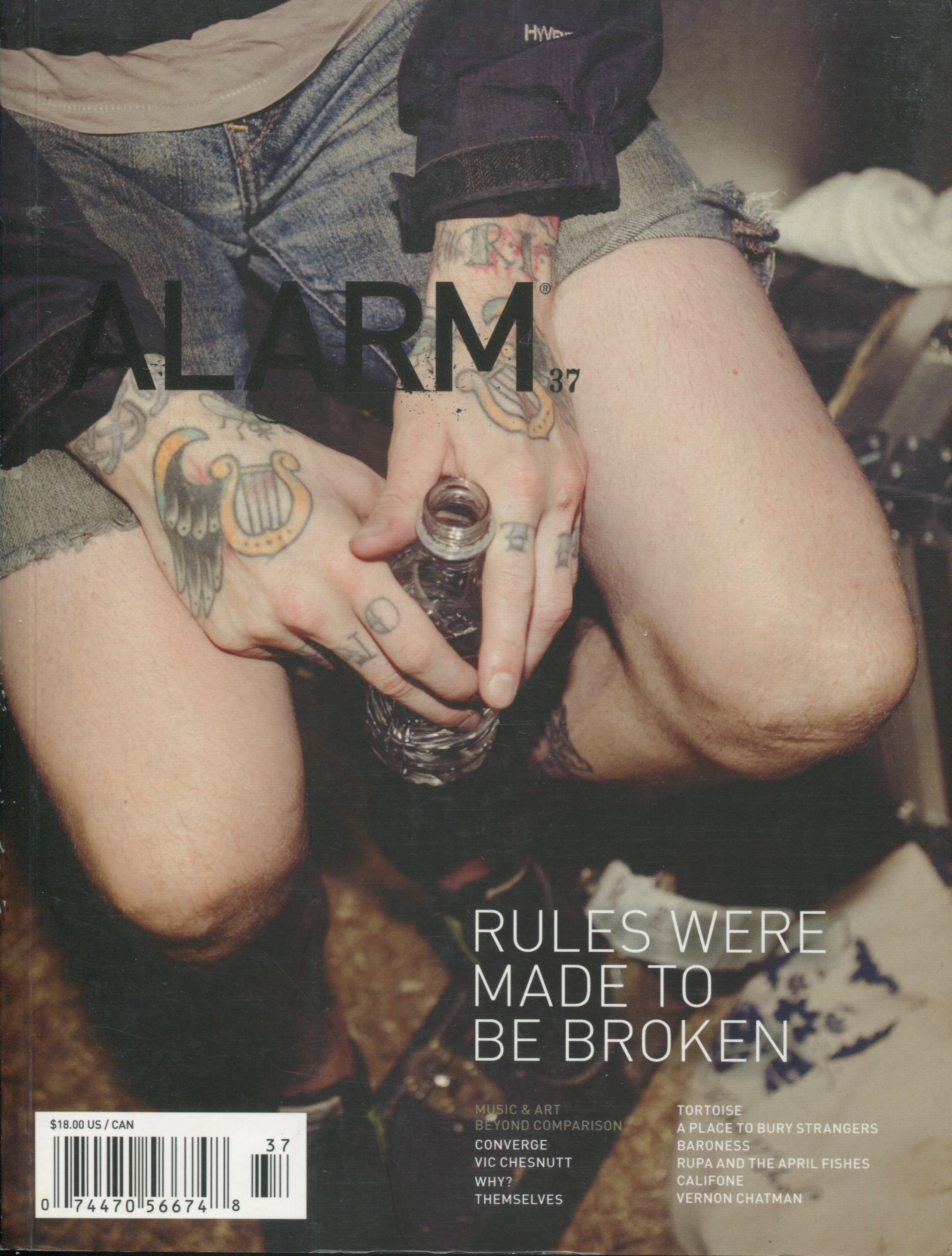
Cover / Alarm #35, 2009 - Fall
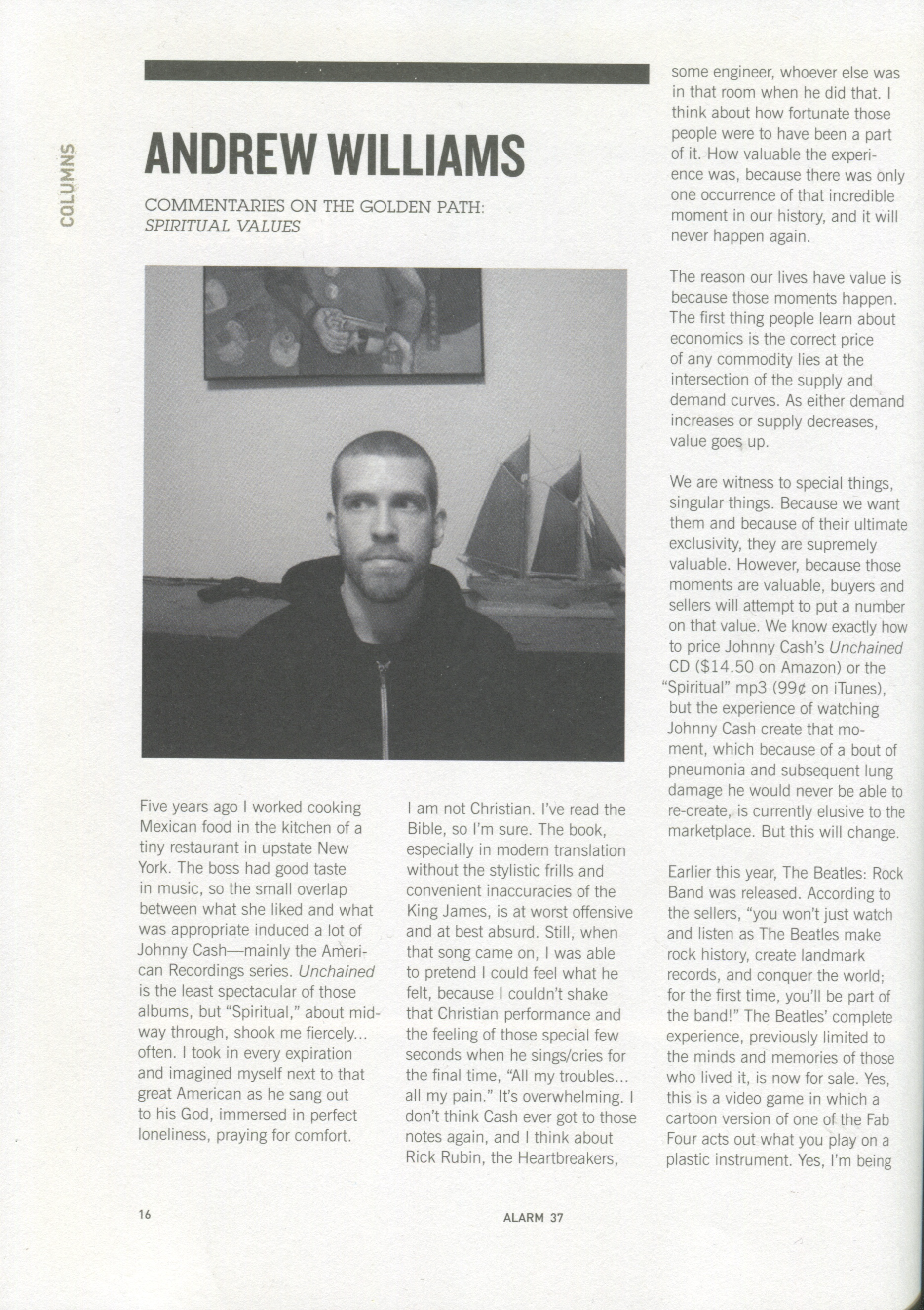
Column scan (page 1 of 2) / Alarm #35, 2009 - Fall
Column scan (page 2 of 2) / Alarm #35, 2009 - Fall
God Particles & Black Holes
Alarm, Issue 34 ·
The Large Hadron Collider as a lens on the war between fundamentalists who answer to the past and progressives who face the future.
Read essay ↓
"There are many theories as to what will result from these collisions, but what's for sure is that a brave new world of physics will emerge..." - CERN
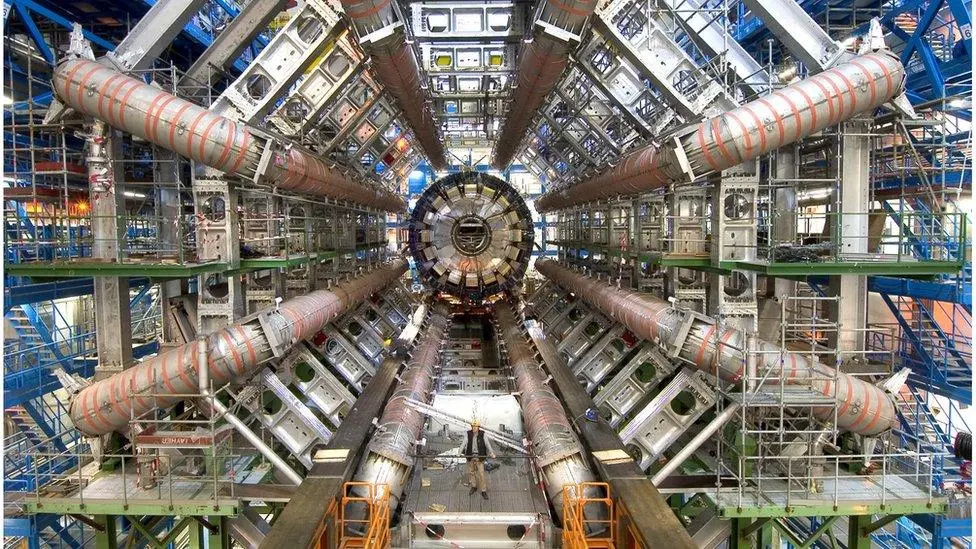
The Large Hadron Collider was set to begin its work smashing the tiniest pieces of existence together. It was revved up on September 10th, with the first high energy collisions to be delivered a month later. Unfortunately, the operations were halted on September 19th due to a fault between two superconducting magnets. We will not know what this thing is truly capable of until this summer when the Collider is fixed and fired up again; however, the goal is to pin down the Higgs boson, the elusive “God Particle.”
I’m a layperson, so I don’t get it. I could probably spend 10 years reading physics books, and I still wouldn’t understand what this thing really does. What I do understand is the LHC could be one of the most important tools of science discovery in our history. Eight thousand (!) scientists from 85 different countries are putting their heads together to get what they can out of the $4 billion project. They hope to come away with the greatly sought-after Grand Unified Theory, which will, according to the scientific community, project us into the future of understanding and awareness.
However, the enthusiasm is not universal. Another (much smaller) group of scientists believe the LHC will create tiny black holes with the potential to consume our planet. While they seem like crackpots, I’m sure these scientists have better brains than mine.
Either way, we are moving towards the future with increasing velocity. And as we accelerate through time, our perception expands relativistically. The things our children will see would have been totaly foreign and extremely unsettling to our grandparents, and the things we know now will prove to be either incorrect or irrelevant to future generations. And this is the key to understanding the two most polarized cross-currents of modern society.
99.9% of humanity is time oriented. This vast majority subscribes to one of two directions: progressives look to the future; fundamentalists answer to the past, and it is interesting that in 2008, the two candidates for President of the United States were such wonderful examples of these opposing points of view. It's easy to draw distinctions between Left and Right, between conservatism and liberalism, between a belief in government responsibility and a confidence in free-market efficiency. However, what's really telling are distinctions of orientation. The election of Barack Obama was, for progressives, a triumphant battle in an elaborate war, a war not of ideology, but perspective.
It's interesting to follow each perspective to it's end:
The fundamentalist extreme adheres to books written thousands of years ago to determine how we should live, and therefore, force others to live in this modern age. It fully ignores the potential of the current and future climate to be affected by different premises than those of the past. It believes we have already been given the solutions to our problems, and if we ignore these solutions, we will continue to head in a wicked direction.
The progressive extreme looks to theories, new operational methods, and developing technologies to bring humanity to a healthier and more just state. It questions the efficacy and worthiness of past cultures and considers the ways of orthodox social systems to be irrelevant. The progressives believe a better world lives in the yet to be discovered, and that the ignorant ways of the past will only hold us back.
Most of us subscribe to a tricky combination of these two ideals. The older generation usually leans to the former, and the youth unsurprisingly lean to the latter. There is value to both, and there is a strong tension, especially in an election year with a divided citizenry. However, time moves in one direction, and no fundamentalist network is powerful enough to prevent our culture from following suit. So, as we are catapulted through an accelerated reality made up of God Particles and mini black holes, we really have no choice: we can look back and pray that our faith will be rewarded, or we can look ahead and know when to duck. Based on President Obama's landslide victory, I believe the majority of us are looking straight ahead, and when the LHC starts humming this summer, we will be ready.
Cover / Alarm #34, 2009
Column scan (page 1 of 2) / Alarm #34, 2009
Column scan (page 2 of 2) / Alarm #34, 2009
The American Balladeer General
Alarm, Issue 33 ·
Seeing Tom Waits live in Mobile, and finding the beautiful, real America worth fighting for against homogeny.
Read essay ↓
“What?…You have no elected officials. It’s like the early days of America, just yelling shit out…Alright, I’m going to have to take over.” -Tom Waits, straining to hear his audience.
I started looking for alternatives in high school. I’m not sure if I was truly uninterested in the forms of entertainment that were made available to me as a 14 year old, or if I purposely chose to reject the teenage culture that seemed to be rejecting me. Regardless, my foothold into the world of the peripheral was 88.1 WESU, Wesleyan University Radio. I found the station in 1993, while scanning the left side of the dial, listening for anything that wasn’t Aerosmith.
One evening the DJ informed me that she would be playing Tom Waits for the duration of the set. I put in a tape and started recording. A few weeks earlier I read a Tom Waits feature in Spin, and I had been meaning to get some of his music since. He seemed like such an oddball, it made sense. That night, I heard the crazy sounds of weird drums and carnival calliope behind a gruff intimidating voice spouting bizarre lyrics, and I wasn’t so sure. But a couple of days later, I gambled $13.99 on Blue Valentine. I thought the combination of the front and back cover was one of the most badass things I had ever seen.
“There’s a place for us…” That magnificent opening line of “Somewhere” pulled me in. The carnival barker was gone, replaced by a fully emotive jazz/blues/lounge lizard. I listened to the album in awe. And then I listened over and over again. Later, I developed a deep appreciation for the later-period Vaudevillian sounds emanating from the WESU tape, but Blue Valentine remains my first and favorite Tom Waits album. It’s a perfect document in 10 songs.
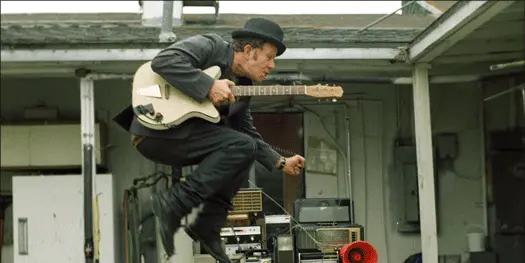
By a twist of fate, Roshni and I had the chance to see the man live this week in Mobile, Alabama. I knew it could be the best shot I ever get, so we flew in on an expensive plane and checked into a cheap motel. We arrived at the vintage Saenger Theater in style, and got to our seats as Waits sauntered onto the stage. Dressed in an old three-piece, a green collared shirt, heavy work boots, and a bowler, he went right into Orphans’ “Lucinda” grabbing the mic stand, waving his fingers in every direction, stomping up dust, and howling. The 60-year-old was a sight for sore eyes, but what hit me like a train was the voice. He’s the Sandy Koufax of vocal power and command, barking fire, stopping on a dime, switching to eerie falsetto, and back again. Perfect. He went into “Falling Down,” and tears came. I could barely take how beautiful he was.
Over the past 15 years, I’ve come to honestly love the man. He is a distinctively skilled craftsman and an imaginative visionary, two qualities that rarely come together. The stories of his songs will remain with me until I die, like a parallel world, more sketchy and hopeful and ugly and beautiful than the one I’ve dealt with. His version of America is the one I want to live in. His brand of Americana is the one I want to buy. He is the ideal ambassador for a different reality.
There’s a battle going on right now. It’s a battle against chain stores and strip malls, against bland food and bland fashion, against marketing calculations and cultural formulas, against mindless consumption and thoughtless disposal…against homogeny. When I traveled from New York City to Mobile, Alabama everything looked the same. I couldn’t really tell the difference, and there’s something awful about that. It makes me want to fight, and I’m not the only one. There’s a battle going on, and this man is in the thick of it. He’s a Balladeer General with an indomitable spirit. He fights for beauty; he fights for meaning, he fights for a real life that has fallen by the wayside, and he fights for America.
Fifteen years ago, I saw the world as an ugly place, and I looked for something different. I would listen to those old songs, and embrace a fantasy of a time that passed, a time that seemed too beautiful to have ever been real.
It’s taken me all this time, but now I understand. I saw that man, how he acts and how he sings. That world exists, and it’s there for us. Sure, every once in a while I’ll have to buy coffee from a multi-national corporation, maybe I’ll have to get a mass-produced light fixture from a big box home improvement store. I may even catch a few episodes of a show designed to manufacture artificial celebrity out of dull Americans. But as long as I remember that’s the fantasy, I’ll be okay. The real world is the one that’s beautiful, the one I can feel.
Cover / Alarm #33, 2008 - Oct / Nov
Column scan / Alarm #33, 2008 - Oct / Nov
Hard Entertainment
Alarm, Issue 32 ·
How broadcast news mutated from hard journalism into hard entertainment, a dying beast spitting blood.
Read essay ↓
"Now I know some of you may not trust your gut...yet. But with my help you will. The 'truthiness' is anyone can read the news to you. I promise to feel the news...at you." - Stephen Colbert
A functional society is an ecosystem of cooperative and competitive systems. These entities provide strength, balance, and hopefully a capacity to fight toxins in their midst. A dysfunctional society, therefore, is one in which certain organisms grow too powerful and dangerous as a result of other individuals or other institutions being unwilling or unable to check their excesses. These monsters grow large with the ability to do tremendous damage. But even with nothing standing in their way, sometimes even the most powerful organisms die. They may rape their environment until it becomes uninhabitable, or they could prove unable to adapt to a new climate, or they might become infected and zombified.
The broadcast news media is one such dying beast. While it continues to grow like a tumor, it looks out the window and sees an unfamiliar world, and it looks in the mirror to see an alien reflection. And it is fevered, spitting blood and gasping for breath.
The way the networks have covered the 2008 presidential primary season is an indication of their deteriorating state. Instead of reporting on substantive issues and delving into policy (never mind doing actual research), they have put gaffe politics front and center. I'm not naïve. I know this occurs in every election cycle. And I know many claim that this is bound to happen during a primary tighter than any in recent memory with two candidates who share similar positions on many issues. However, there is more to it. Both the quantity and the timbre of the non-issues put front and center is a clear example of a tectonic shift in the world of broadcast news, a shift from hard journalism to soft journalism to hard entertainment.
There are a few reasons this is happening now:
1) The expensive capital investment previously needed to run a news agency is now unnecessary. High-power transmitters and ownership of the radio spectrum and cable bandwidth are no longer critical to the dissemination of information.
2) The flexible structure of the internet and the ease with which content providers can broadcast information to the public (i.e. RSS feeds, podcasts) has resulted in political news seekers viewing the internet as a more thorough and satisfying source. Sites on the right (Drudge Report) and the left (Daily Kos) have not only been successful—they have often managed to dictate the agenda of the news networks. To the previous point, it should be noted that, before the advent of the internet, people like Matt Drudge (a gossip columnist) and Markos Moulitsas (an Army veteran and manager of a college newspaper) could not have been expected by any rational human to become two of the most influential members of the media in a few years time.
3) The critical and commercial success of comedic news shows like The Daily Show, Politically Incorrect, and more recently The Colbert Report have influenced hard news shows to embrace a more absurdist take. This last point is the most notable because it has (at least in the short term) worked. There's no denying that the O'Reilly Factor, despite having little journalistic integrity, is an enormous success. It could be argued that the show, along with the network on which it was born, redefined cable news.
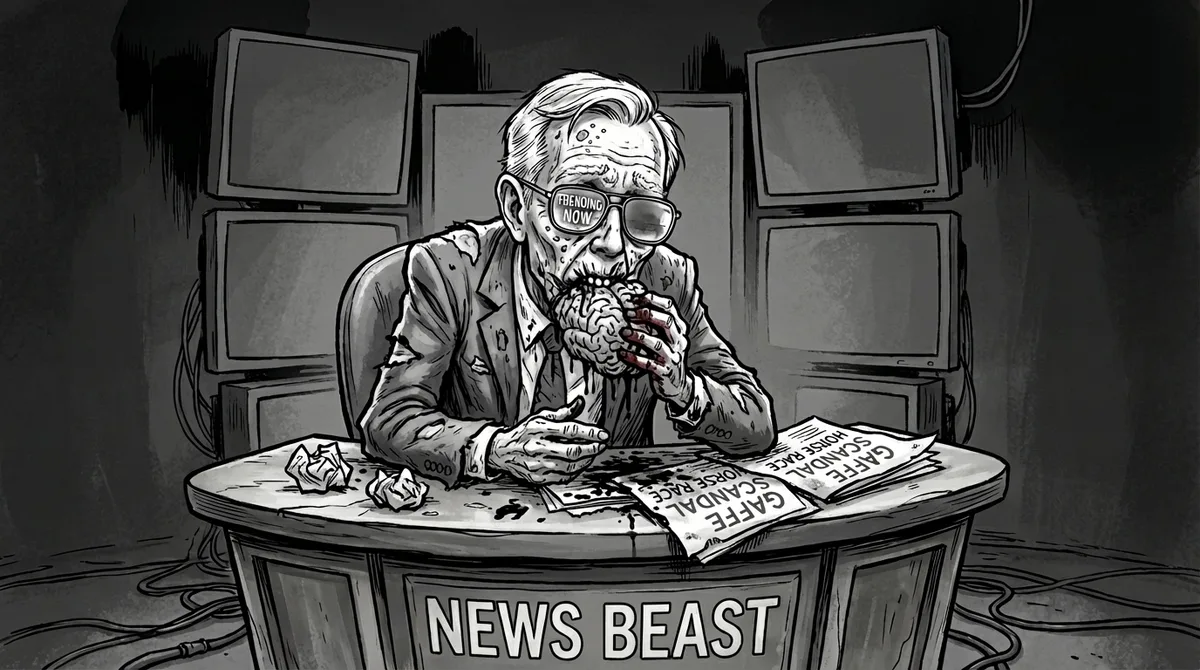
So here we are, and Charlie Gibson isn't really sure what's going on. He sees an unfamiliar world where a couple of guys with a domain name and an internet connection have gained more influence in the political landscape than his once-mighty ABC News empire, and he's trying to figure it out. So when the spotlight is on, he focuses on the gaffes and trivialities that have done wonders for the comedians and the pundits, and in the process, he contributes to the degeneration of his profession. I think about what it will be like a decade from now. I imagine an old Gibson, covered in age spots that makeup can't hide, desperate to stay relevant to a new generation with little patience for a half-hour static newscast. I imagine a monstrous thing, staggering along, spitting blood and vitriol...a walking corpse.
Cover / Alarm #32, 2008 - Aug / Sep
Column scan / Alarm #32, 2008 - Aug / Sep
The Structure of Expectation
Alarm, Issue 31 ·
A Super Bowl upset as proof that the random nature of existence still beats our addiction to prediction.
Read essay ↓
"G-Men! Money Line. G-Men! Money Line." - Brooklyn Resident yelling to no one in particular the day before the Superbowl XLII
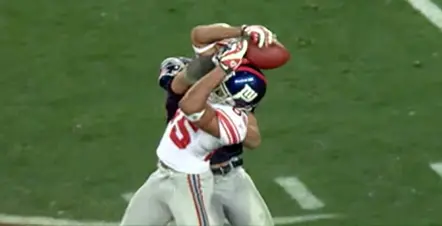
I watch Manning get sacked and my heart stops. But then, inexplicably, he isn't. He runs free, away from the pocket and throws an almost-spiral to the middle of the field. The confidence on that ball means a reception. So my heart stops again when I see Rodney Harrison jump up, grab Tyree’s left hand and reach for but miss the right, which is pinning the ball to the receiver’s helmet. Inexplicably, Tyree, with Harrison attached, falls 8 feet out of the air, hits the ground, and still has one hand and one helmet on the ball. Jim screams, "He caught it with his BRAIN!"
Two more perfect completions, four desperate heaves (the last with the big-play pie in my mouth), and the game is over. Me yelling, "Is that it? Is that it?" as crumbs fly out.
I couldn't believe it, and I was going nuts not just because the team I love won (and for the first time in a long time I remembered what it felt like to be an overweight suburban 7-year-old fascinated and worshipful of the raw determination and unstoppable will of Lawrence Taylor), but also because the opinions of a nation were made null. The story that was supposed to be did not happen, and once again the random nature of existence triumphed over the structure of expectation.
Most humans live boring lives. And even if we never complain about it outwardly, most of us feel it, and it gets to us. We talk about how we want to shake things up, try new things, give it a whirl, test our limits. But at the same time a huge percentage of our attention is devoted to making sure we are never surprised by anything. There is a reason the weather report is at the end of the newscast. People will be more likely to sit through a retelling of the day’s events in other parts of the world/nation/state if eventually there will be some insight offered into whether it will be better to wear boots or sneakers in 12 hours. Right now, during the election season, polls dominate the headlines/talk shows/blogs even though we've seen so many pollsters (I'm looking at you Zogby and ARG) put up such inaccurate numbers. It’s hard to see the difference between them and the typical astrologer (except for the swimming pools full of cash they spend their days lounging in).
I admit I'm as guilty as anyone. I'm addicted to Daily Kos. I constantly monitor RSS feeds for the latest numbers, and on the evenings of primaries, I'm fixated on results from any state with more than 10% reporting. I even have money riding on Obama winning both the nomination and the general election (Vegas was actually giving Clinton better odds after Super Tuesday!).
I wasn’t always like this. At one point, I decided the responsible thing was to be an informed citizen of the world. So, I started going easy on the fiction and imbibing a healthy dose of current issues. As I read the weeklies, dailies, and blogs, it became apparent that I wasn’t incredibly informed, so I read even more. But somehow the more I read, the less informed I felt and the more I needed to know. I clamored for fresh opinions based on the most recent events. I delved more and more into analysis and prediction, and shortly after, recent events became increasingly less interesting. What really mattered was what would happen tomorrow. Now it’s to the point where nothing surprises me. Somewhere there was some analyst who saw it coming, whatever it is, and more likely than not, I got that take.
So, I’m giving it up. I am going work towards being stunned by things again. I want to not be concerned with what’s coming around the corner. I want to live in the present.
I felt so much joy on Superbowl Sunday, more than I’ve experienced in years. Mainly, I felt joy for the young man who for years was trashed by an entire city, mocked for looking like a dope, and accused of not being a leader of men. In less than a month, I watched him become what everyone said he was not. With one spectacular completion, he transformed himself from a heel into a legend, and no one saw that coming. That’s what this whole thing should be about.
Cover / Alarm #31, 2008 - Jun/Jul
Column scan / Alarm #31, 2008 - Jun/Jul
Wheels out of Kilter
Alarm, Issue 30 ·
Using Daniel Day-Lewis's tyrants and his years as a cobbler to ask whether American power can ever humble itself.
Read essay ↓
Daniel Day-Lewis is my favorite American actor, even though he’s not American and rarely acts. In his last two major motion pictures, Day-Lewis brilliantly projects both sides of a quintessential American coin. In Martin Scorsese’s Gangs of New York, Bill the Butcher is the embodiment of raw political talent. Likewise Daniel Plainview is a flawless portrait of economic determination in Paul Thomas Anderson’s There Will Be Blood. Both characters take the American persona to its logical extreme, and Day-Lewis’ portrayals are rife with the passion and zeal that make these historical caricatures unassailable in their American-ness. The essence of Bill the Butcher and Daniel Plainview have shaped this land politically, economically, and culturally for the last 400 years. In all their grotesque splendor, these two men, more than any other combination of adjacent characters, are who we are. This nation rose to prominence on ambition, aptitude, and ruthless opportunism. And like this nation, these two men are propelled by their need to be masters of their environment and lust for absolute control, even when it means sacrificing any trace of humanist spirit. And indeed, they conquer everything in their path, until they learn (coincidentally at the moment each loses his adopted son) that all things are impermanent and the unmanageable nature of existence ultimately triumphs.
In real life, Daniel Day-Lewis is very much the opposite. When Scorsese located him to do Gangs of New York, the Academy Award winning actor was living under the radar in Italy, obsessed with the craft of shoemaking to the point locals thought he was apprenticing to become a cobbler. Day-Lewis hadn’t worked in almost half a decade, and dreaded returning to Hollywood. However, once he took on the role, he fully immersed himself. For the duration of the shooting, on and off camera, he was the American tyrant, an inhuman icon willing to sacrifice everything in order to dominate the landscape. And he made everyone else involved in the world of cinema that year look like an understudy. After the film, he retreated from public view again, and aside from a role in an independent film made by his wife, Day-Lewis stayed away from the big screen for another half-decade. Then, a few months ago, he returned, playing another tyrant, this one an obsessed hunter of the black blood that has dominated American life throughout the last century.
The Bill the Butcher/Daniel Plainview vanguard is the current model of American leadership. They made this nation the way it is, and they are who we are destined to become. The leaders of this land treat other world leaders as, at best, contrivances to do our bidding, and at worst, ideologues hell-bent on our destruction. Most importantly, they are never treated as equals. The U.S. government writes their policy, exploits their resources, and/or threatens their viability. And our leaders do this offensively, like bullies, because they have always done things this way, and it has always worked.
But will it continue to work? If one day the world changes and populations can no longer be bullied, coerced, and manipulated, or even worse, if it becomes apparent that our political and economic might will no longer protect us from the realities of life outside of our borders, will our leaders be able to adapt and retract themselves? Will they be able to do what the Daniel Day-Lewis characters could not, or will they insist on continuing to trample the Earth, riding high on wheels out of kilter? Will the powers that be sacrifice our soul in order to dominate the environment?
I think of myself as a simple person. I aim to be content with what I have, and I intend to constantly appreciate the beauty of this existence. Therefore, I have tremendous respect for a man who is fascinated by and spends years of his life observing the art of making shoes, especially if the man has the talent and charisma to dominate. This man knows the true meaning of enrichment, and in the 21st Century, the quality is rare. Among the individuals who lead our nation, the quality is non-existent. I try to imagine what the world could be like if these leaders were rational individuals, free from the desire to impose their will on all they see. But I can’t, because I can’t imagine any American of significant power willing to submit humbly to a simple cobbler.
Cover / Alarm #30, 2008 - Apr/May
Column scan / Alarm #30, 2008 - Apr/May
Movement and Escape
Alarm, Issue 29 ·
Why discontent drives us to travel through space when we cannot travel through time, caught between escape and the search for knowledge.
Read essay ↓
“I want us to make this trip a spiritual journey, where each of us seek the unknown, and we learn about it.” ~ Francis Whitman
Human beings are generally discontent. I think that’s one thing the majority of us can agree on. Most of us believe that we can be content or that we will someday be content, but very few of us think we’ve gotten to that place and are living it. Often times we look back and persuade ourselves that we used to be content, that the past gave us feelings that have since gone extinct. But the here and now is rarely enough. Most of us want to be in another time. We want to be in the future when our debts are paid or in the past when we didn’t owe anyone anything.
But in most cases, things weren’t better before and things aren’t going to get any better in the future. What we really want is to believe that this is not all there is. Because if this is all there is, then it’s our responsibility to do what we want with ourselves right now, and I don’t think most of us can handle that type of responsibility.
Instead, we wait for the future or we pine for the past, and we are resigned to the fact that we cannot travel through time. For most of us, that is not enough. Most of us believe that if we cannot travel through time, we can at least travel through space. So we journey, either by bicycle, airplane, or mind-altering substance, and this is the source of the modern human’s obsession with movement.
There are two distinct goals of travel and two distinct personalities associated with each:
1) Escape - The escapist has an inclination to move through space, and/or a compulsion to move through an alternate state of consciousness, but always a movement away from where he or she is. The assumption is that because the individual is not content, the current location cannot offer contentment, and the need arises to move toward something else. Almost always, the escapist never finds the place he or she is looking for, but occasionally finds the eternal search for that place offers a kind of solace.
2) Knowledge - The assumption of the individual seeking comprehension is that he or she needs to have a sense of context and needs to understand what exists out there in order to make sense of what is right here. There are places that specialize in offering this type of insight, places like India and Tibet, Mount Everest and the Arctic, Coney Island, and the Brooklyn Botanic Garden. Some of these places charge a considerable fee.
I’m not sure which of the two applies to my situation. I want to believe it’s the second, if only because I love New York City so much. I can’t imagine any other place where I’d rather spend this part of my life…but still, I’m itching. I’m itching to move away from where I am mentally and where I spend most of my time physically (in front of a computer screen). It’s even in my dreams now. I see landscapes, I see foreign worlds, and I see animals that don’t exist. I see the places I want to explore, and they are so unlike the place I inhabit. Sometimes I wonder if this culture is so far gone from the place my ancestors adapted to that my instincts are rebelling. I wonder if one of these days my brain is going to refuse to see an artificially illuminated screen of data because it knows that data analysis was not the purpose of my design. And I wonder if one of these days I am going to wake up and start moving quickly in no particular direction except away from here and towards something completely opposite.
Unfortunately, I’m fairly certain that will never happen. Humans (me included) don’t have the guts to do what we really want and what our bodies are made for. Instead I’ll convince myself that contentment will come from an exploration and an eventual appreciation of accessible places. I’ll probably take a trip to India, and when I fall asleep on that spiritual journey, I’ll be dreaming of foreign worlds and non-existent animals.
Unfortunately dreaming doesn’t pay the rent.
Cover / Alarm #29, 2008 - Winter
Column scan / Alarm #29, 2008 - Winter
An All-Embracing Hug
Alarm, Issue 28 ·
On American identity as power through inclusion, and the people who see nothing of value in our all-embracing hug.
Read essay ↓
"The sunlight that brought light and healing to you has brought stripes and death to me.” – Frederick Douglass
On Wednesday, as I watched Joey Chestnut set a world record for most hot dogs and buns eaten in twelve minutes, I thought about how to assess my identity as an American. It is a confusing thing for me.
There are so many things about this place I love without fully understanding why I love them. Why do I love The Western, a literary aesthetic celebrating many concepts in opposition to my sociopolitical ideology: isolationism, power through brute force, manifest destiny, ect.? Why am I obsessed with baseball, a game that has grown more and more inextricably coupled with consumerism, drug use, and public funding for private business? Why would I, a strict vegetarian, become so enthralled with a hot dog eating contest that I scour multiple news sources for details about a threatening jaw injury two weeks before the event?
But there are many American creations I love for good reason.
Because of different policies both horrifying and far-sighted, the United States became and remains the most diverse nation on the planet. The intermeshing of previously homogenous cultures provided us with a huge economic advantage and unparalleled cultural invention. Tap dance, jazz, rock ‘n’ roll, and countless other creations in fashion, visual art, literature and cuisine would not have been possible anywhere else. Part of the reason it is hard for me to understand what it means to be an American is because it means so many things. We are not a breed. We are mutts. Even the pureblood Cherokee or the WASP with a pedigree stretching back to the Mayflower has been infiltrated one with the other, if not by blood then by common geography.
I believe America, more than anything else, represents the idea of power through inclusion. We have arguably dominated this planet as well as any other empire on record, and we have done it not through military conquest (at least from 1898 - 2003), but through persuasion and co-option. We have reaped the resources of other nations, spread our economic wealth to a lucky few, and brought the majority of the world into the fold. For good or ill, the economic system we champion has made it inevitable that A) the future of the world will be closely aligned with the way of America and B) we will continue to fight wars with those who wish to remain economically and culturally independent. The American idea of Manifest Destiny has evolved beyond geographical boundaries. Now we move to create one international community in order to imbibe the nectar of global production.
That’s why it’s interesting that on the Fourth of July we celebrate a sundering. The fireworks we watch, the symbolic bombs bursting in air, represent our struggle against imperialism and for an independent American identity. The Founding Fathers went to war behind a belief that Americans should dictate their own destiny and reap the rewards of their own labor. The idea behind the American Revolution was that is not right for a people to work for the benefit of a power in another hemisphere.
Average Colonists risked their lives to free themselves of British power not necessarily because they thought they would be better off (many were jaded enough to see they were simply trading British bosses for American bosses) but because Britain offered little in exchange for American subordination. Colonial Americans paid taxes to a government that did not allow Colonial representation, instituted unfair trade policies, and was associated with luxury, corruption and inherited aristocracy.
And now nations on every continent willingly offer their economic futures to an American Government with eerily similar characteristics.
Why?
Because in exchange for cooperation, cheap labor, and an enormous consumer market, we offer something they cannot decline. We offer our music, our fashion, our cuisine, our cinema, our culture both high and low, our hunger for product and our need to consume. We offer our identity and the potential to become a part of us. We offer what we love.
And because the culture and gluttony of America is so appealing, we have not had to fight to dominate. The majority of the planet rightly or wrongly has walked enthusiastically into our all-embracing hug.
But there are those who oppose an American infestation of their culture, their government, and especially their land. They are the ones who see nothing of value in what we offer, and according to the United States Intelligence Community, their numbers are growing. They are willing to kill and die for their independence. And the American government has made it a point not to let their insolence go unnoticed. But we don’t know what to do. The tactics of the Bush administration have failed, and the party of opposition has yet to prove they have a plan at all.
Meanwhile, for their own benefit or detriment, those currently fighting for independence are satisfied watching the bombs bursting in air.
Cover / Alarm #28, 2007 - Fall
Column scan / Alarm #28, 2007 - Fall
Mysterious Cities of Gold
Alarm, Issue 27 ·
How a childhood cartoon bred a lifelong hunger for context and completeness, and why most people would rather be understood than understand.
Read essay ↓
Some of my finest childhood memories are from the days I would opt out of school. I would either be sick or exaggerate the mild discomfort I felt, con(vinc)ing my mind and my parents that I was really ill. Either way, I felt I deserved a day off, and I would do what had to be done to stay in their bed where I had access to TV, and bask in the pleasure of watching cartoons normally unattainable because of school obligations. There was a lot of bad Nick Jr. shit on during the day, a lot of stuff created for little kids I grudgingly sat through. But I watched and waited until the show that made it worthwhile came on, the show that affected the way I consume and appreciate serial style cultural creations, the show that fostered my love for the epic saga and was responsible for my obsession with context and completeness: The Mysterious Cities of Gold.
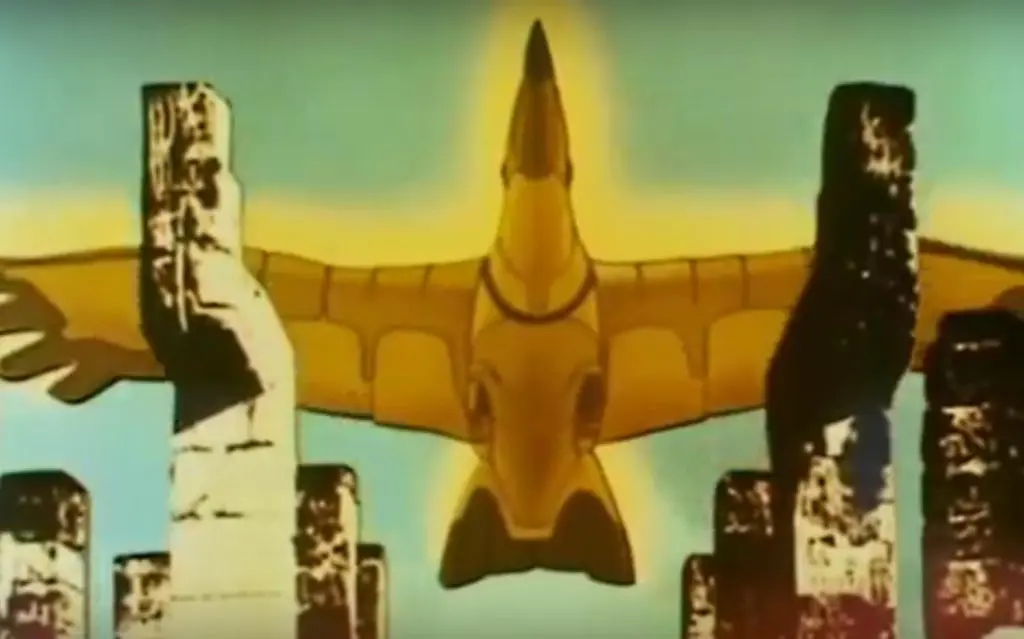
The first time I stumbled upon it, I had no idea what was happening. The opening credits showed three children flying a huge mechanical bird. For whatever reason, that blew my nine-year-old mind. It began with a “previously on,” the narrator coming at me with a few weird names and a couple of enigmatic plot points. I didn’t get it, but I tried to follow the action and waited for the bird-plane. Slowly I gained a sense of the characters, and I realized the story took place in South America some time way in the past, but with interspersions of futuristic technology. I was still pretty lost, but Esteban was my type of kid, and I really liked the music. I stayed home again the next day, and I was able to understand a lot of what was happening because the episode was a continuation of the previous one. Now I got it. The show wasn’t intentionally confusing. I had only watched a tiny piece of a massive narrative.
After those two days, in the time before DVDs and DVRs, I looked forward to watching the show whenever I was lucky enough to be home in the early afternoon on any given weekday. The series ran from beginning to end and then repeated, so at any time I could be watching events that took place before or after episodes I had previously seen. I was continuously confused, but I always hoped to see the episode with the huge mechanical bird. Once, for an entire school-break week, I was able to immerse myself in the story. That Friday they began talking about a Golden Condor, and I thought my time had finally come. Instead, I was left with a cliffhanger and the realization the bird-plane would make its first appearance while I was stuck in school on Monday. Unfortunately, I never got to see how that Golden Condor came about. I saw the solar-powered ship, which was almost as cool, but the Condor remained out of reach until I finally got down to business and bought the entire series on ten VHS tapes off of eBay in 2001.
Recently, I’ve come to understand the importance of The Mysterious Cities of Gold in my preferred form and aesthetic. As an adult, I find myself unable to enjoy cultural products without drawn-out plot lines and intricate historical, geographical, and mythological contexts. It’s hard for me to immerse myself in the typical half-hour sitcom because it feels like an insubstantial waste of time. Instead, I’d rather watch an entire season of a series like The Wire with all its cultural, professional, political and regional complexities. And instead I fill my bookcase with literary chronicles containing plotlines spanning thousands of pages about individuals and cultures that may or may not exist, but nevertheless are alive with substance. Instead, I fill my record shelves with the complete works of individuals and groups who have defined and/or defied the customs of a few distinct musical sub-genres. And instead, I define my years alongside the ultimate saga of professional baseball with its endless cycle of pennants, rivalries, dynasties, and its extensive cast of legendary characters. This is my struggle for complexity and totality. If I want to be involved in something, I need to be aware of the beginning, the end, and everything that comes between. Without a detailed context, I am disoriented and disinterested.
As a society, we are poorly informed. Many problems (especially in the foreign-policy arena) could be dealt with intelligently and efficiently if we increased our focus on understanding historical and cultural context instead of insisting on an agenda that may or may not be applicable. This is what we should expect of our elected officials and ourselves; however, most people don’t care. They don’t care for context; they don’t care for a rich understanding. Because most people care only for what they can draw conclusions about with minimal effort. Most people don’t want to understand; they want to be understood, and I wonder if I’m different because the TV show that gave me respect for context and thoughtful understanding only aired when I was supposed to be in school.
Cover / Alarm #27, 2007 - Summer
Column scan / Alarm #27, 2007 - Summer
The Fall of God
Alarm, Issue 26 ·
Artificial life as the central plot of human existence, and how building our own Adam and Eve flips Genesis on its head.
Read essay ↓
“Robots might one day be smart enough to demand emancipation from their human owners, raising the prospects they'll have to be treated as citizens, according to a speculative paper released by the British government. Among the warnings: a ‘monumental shift’ could occur if robots were developed to the point where they could reproduce, improve or think for themselves.” – The Associated Press
“You won’t die! God knows that your eyes will be opened when you eat it. You will become just like God, knowing everything, both good and evil.” – The Serpent
The main plot and central theme of human existence will become the creation of artificial life and the treacherous road leading us to that precipice. I see no other worthy purpose for our dangerously intelligent minds and incessantly thoughtless actions. The idea has been explored repeatedly in the Science Fiction Canon, and if there is a single theme espoused by those who write about the future, it is that we shouldn’t trust robots.
This is not surprising, as the theme is really a variation on another, one of the oldest themes of human storytelling: the fall of Adam and Eve. When Adam and Eve succumbed to the Serpent’s temptation and ate from the Tree of Knowledge of Good and Evil, they became enlightened. For their disobedience and transgression, God forbade them to return to the ignorant paradise they were born into. The idea that humans would gain knowledge, thereby stripping God of power, and the idea that humans would come to dictate morality on this planet, thereby stripping God of authority, is the force behind the account of the original sin. Our ancestral storytellers anticipated the power humans would one day wield, even before the Earth was tamed. These ancestors found the fable is so crucial they inserted it into the second and third chapters of the most important physical document of their culture and the most ambitious work of scholarship to that point.
The process of humans becoming gods began long ago when Eve took a bite of fruit, and according to the U.K. Office of Science and Innovation, it could come to completion within 50 years, when we finalize the construction of beings who can reproduce and, more importantly, dictate their own morality. I hope I am around to witness this. Nothing makes me want to live a long life like the potential to watch one of the most famous stories of humankind play out in a contemporary setting. I want to see humans evolve from the created to the creators, flipping Genesis on its head.
After all, our maker is as good as gone. Even the devout cannot claim He is present in the way He is described in the Old Testament, laying down laws, conspicuously punishing and cursing us when we break them. We have fatally wounded Him, or the idea of Him, by making our own rules, enforcing our own punishments, hijacking control of the planet, and now finally developing other beings to entertain and do our bidding. When humans began asserting independence from the laws of nature, we also asserted our independence from that which designed us. And when we ultimately master the ability to create like our creator, we will hammer the final nail in that heavenly coffin. At that point, humanity will have fully transformed and transposed itself into something greater. In the 21st Century there will not be one god, but thousands, any of which could create the modern Adam and Eve. And how long will it to take for that legendary couple to take a bite of fruit, become fluent in their own programming, and realize humans serve no purpose. This will be the Fall of Man. Just as the original Fall was not Adam and Eve’s, but the Fall of God.
Fifty years is not a long time. In 1957 humans had recently created the Hydrogen Bomb, paving the way for total devastation to be flung easily throughout the world. Thoughtful contemporaries believed we had become too powerful, and the Nuclear Age would lead to humanity’s demise. What the hippies did not consider, however, is that ultimate power is not born of destruction but creation. Monsters are easily conquered with brute force; gods can only be destroyed through obsolescence. Therefore, if humanity comes to an end, it will not be because we are monsters, but because we have birthed offspring who are smarter, stronger and more appropriate to this age.
The only question is whether we will allow the scientists to proceed. The history of our modern culture is rife with examples of humans enthusiastically submitting their collective authority to a select few. We pay for a military to dominate foreign peoples while we fight for legislation to disarm ourselves. We let the tycoons of Wall Street determine our economic well being instead of supporting local business and investing in our own communities. So when the time comes, will we submit our earthly supremacy to those who have obtained the skills to make something better, or will we reign in the power and potential of humanity for the first time? This is the question that will reveal the climax of the human saga: will we fail, or will we fall?
Column scan / Alarm #26, 2007 - Spring
The Bearded Lady of the National Archives
Alarm, Issue 25 ·
On certainty, democracy as the sum of a billion private realities, and how the Constitution became a museum curiosity.
Read essay ↓
“They exist within a culture of confusion.” - manager/producer David Eliade on Fucked Up
Some people know where they stand. These humans see, know and realize. They adore their own faces, and some mirrors are crystal clear. To them, there is purpose, there is meaning, and there is a determination to pour our collective natural environment into a specific ideological container. These visionaries have names like Wolfowitz, Zawahiri, Cheney, Bin Laden, Rove, Hussein and Rumsfeld. They exist in a chinkless suit of armor, and most importantly, they have an unconquerable perspective. It is difficult for unwavering ideology to triumph over real world truths, but these gifted individuals have a remarkable ability to simplify the complex, to subdue the alternatives, and to remain unconfused.
I cannot do it. I cannot get with a distinct worldview. As appealing and comforting as it would be to have solutions for all possible problems, my mind will not work that way. There are things I don’t know, and even worse, there are questions for which I believe there are no correct answers. This is my perspective, and it is weak. Of course I have strong feelings about many things; however, I recognize them as feelings. I understand I am tainted by all I touch, and that the things that appear so obvious may have no correspondence to real world truths. I understand that the thoughts in my brain are made of emotion, not politics, and the combined mental reality of this planet is an amalgam of a billion unique self-contained realities. And this is the point of democracy. Because we are a diverse group of humans with an unlimited number of experiences, perspectives, and belief systems, the closest possible conception of truth should be the only thing left standing after all is said and the falsities on every side have cancelled out. In fact, I believe this is the definition of truth. It is not a single idea, but a collection of ideas, a summation of an immeasurable series of data. No individual knows the whole reality of how things are, but together we can all know it, and it would be obvious if we were able to stop and listen.
The most recent National Intelligence Estimate (or at least the four pages that have been declassified) directly refutes the claims of the Bush Administration concerning the War on Terror. It also tears apart the philosophy, strategy, and tactics directing the War. Yet, despite the contrary on-record opinion from the intelligence agencies that this same administration has staffed, Rove & Co. continues to assert that we are winning, and not only are we winning, but to suggest otherwise is treacherous. I often doubt these people really buy into it. I doubt they understand that this is the line of the typical pre-fascist state. I doubt they think of themselves as potential autocrats. Then I look into their eyes, and I wonder.
In 1942 President Roosevelt decided to suspend the rights guaranteed under the Constitution for a large segment of the American Population. Due to the imminent threat of potential spy-networks, Japanese Americans were detained in concentration camps until after the surrender of Japan. Despite the illegality of the directive, both the Roosevelt Administration and the Supreme Court, which upheld the order, defended themselves, saying the possibility of the threat justified the disregard of these Americans’ Constitutional Rights. The directive is still being debated; however, the dispute was made irrelevant the moment the first Japanese-American was locked behind a fence. When the President stripped those people of their rights, he simultaneously stripped all power from the document that was made to be the Supreme Power. With a signature he turned the thing that rules these lands into a cheap knickknack. Because the document did not stand when it was really tested, when it was supposed to be at its strongest, and because the rules were not followed when they were no longer seen as helpful to the powers that be, the Constitution of the United States of America was shown to be an incompetent fraud.
What was true then is true now. Are we surprised when pieces of legislation like the Terrorist Detainee Bill are passed? It was passed because this whole thing is pretend. The Constitution is a piece of paper in a glass box in a fancy building in Washington, D.C. It is a cheap thrill for people who happen to pay a small admission fee and walk by. It is the bearded lady of the National Archives. It is there with The Declaration of Independence, The Articles of the Confederation and other obsolete records of a former time. Its only real function is to subdue confusion. Because all the rules are written down, and because everybody has a copy, we never need forget how the game is played.
But the game is fixed, and we should be upset. We should be uneasy and insecure, if for no other reason than the Administration’s assertions of pure clarity. They know exactly what they want and exactly how they want it, and they will not have inconveniences slow them down. When they stare into the quagmire that is Iraq, Afghanistan and the majority of the Muslim World, they feel no uncertainty, and they will not stray from the course. And I find myself trapped in a culture of confusion because I cannot believe it is safe to embrace a world dominated by fanatics.
Cover / Alarm #25, 2006 - Winter
Column scan / Alarm #25, 2006 - Winter
My War Is Personal
Alarm, Issue 24 ·
A dispatch on the private battle for Order against Chaos, and why order turns to oppression the moment it extends beyond the self.
Read essay ↓
To whom it may concern:
I am busy. I am writing to you from a crowded elevator…and from a subway car…and now from the middle of a heavily trafficked intersection. I write to you by way of the wireless PDA issued to me by the corporation I work for. Since they rob so much of my time, I try to compensate the loss using their materials. Because I am a good soldier. I constantly battle, and I fight hard for their world order. And because I know they will never stop taking, and I realize the battle will never wane until I am through on this planet. A few generations ago my ancestors fought different battles. They fought a war of survival. They fought by any means necessary to sustain their own lives and the lives of their family. They farmed land, labored in factories, hustled, robbed, and scammed. For me, survival is not an issue because I've never been hungry. What I battle for is not my life but my mind. I fight to control the uncontrollable and dominate the indomitable. The human campaign of the 21st century is a war against Chaos; however, the fight is in vain because we battle the culture we evolved into. We the battle the God that made us, and we battle the plan that has been handed down.
I usually read about 5 books at a time. Right now all 5 are explicitly concerned with the same conflict: Order versus Chaos. The coincidence has made me think hard about the timeless duality. And what has made me think even harder is the fact that of these five books, three are fiction, and the same three ally Order with the Protagonists. And of these five books, two are non-fiction, and the same two argue Order always comes to be an oppressive quality of the Human Condition. I read comic books, science fiction, and fantasy novels; so it makes sense that a belief in Order as Salvation is a fantasy. This belief comes from a cultural drama that will never be resolved because the real-world reflection of the cultural production never has and never will exist. However, I have bought into the fantasy, and I believe chaos to be my enemy. I am engrossed in the domination of my environment, and I have had few thrills like discovering how to correctly use indents and tabs in Microsoft Word. And I am counting the days until I can move into my new apartment, where I will create a structured environment from scratch. And I avoid drugs and alcohol because I don't fully trust my mind in an altered state. I have enlisted myself on the front line of the campaign for Order, but with one prerequisite: my war is personal.
I feel myself changing. I am becoming fully aware of grids and containers and systems. New York City, made of containers, built on a grid, and filled with millions of interconnected systems is particularly attractive. Except New York is a city of chaos. Madness thrives in The Grid, and nothing is more attractive in the external world, outside my mind and outside my office, than an environment defined by an extreme abundance of irrationality, and therefore, I thrive. And that is the key to sustaining myself in this war. Order becomes Oppression at the point where it is extended beyond the Self. As I control my mind, my space, and the systems I am paid to maintain, I observe, appreciate, and become one with the inexplicable lack of system that exists outside my control. Alternatively, Robert Moses, the 20th century “Master Builder” of New York City, dominated, shaped, and oppressed to a degree rarely achieved in a place so large. However, the Planner died discontent because he could not defeat the chaos infused into this place. He only thought in artificial systems, he underestimated the efficacy of individuals, and he misunderstood the ultimate organizational scheme.
Chaos, properly applied, is a perfect system. It is natural, and we are born from a natural place. As we fight to control the insides of our minds, we should learn to wonder at all that is on the outside. Because it is beautiful, and it is powerful, and it will never make any sense.
Cover / Alarm #24, 2006 - Fall
Column scan / Alarm #24, 2006 - Fall
The Golden Calf of the Future
Alarm, Issue 23 ·
On gluttony, endless consumption, and how we worship the upgraded future instead of mastering what we already own.
Read essay ↓
With power comes gluttony. This should be a law. It should be written into texts as an unassailable truth like every other law of science until it is proven wrong. We are a nation of fat people, and our fat is stored not only in our bodies, but in our homes, our hard drives, and in our heads.
Technical details: the health and power of our culture is based on the rate at which we consume (or more accurately, the pace at which this rate of consumption increases). The better off we are, the more things we will make, the more things we will have, and the more things we will want. This is paradoxical at the level of the individual. If power can be defined as the ability to fulfill desires, then an individual’s power can be increased by either A) increasing one’s ability or B) reducing one’s desires. The psychology necessary to make our economy strong, the psychology of credit card debt, of gadgets, of software upgrades, is a psychology that makes individuals weak. Our hypothetical desires will always be one step ahead of their real-world realizations. The glutton does not appreciate what is consumed, but only that there is more coming, that there is an endless supply. We are through worshipping Golden Calves; we have gone beyond alienating ourselves from the objects we produce. The current human worships the bigger, upgraded, to-be-released Golden Calf of the future, so now even our desires are alienated, and an imagined potential dominates our real lives.
And this problem extends beyond the tangible, as we are loaded down with more than product. Whenever I ride the train to work, I’m assaulted by newspaper hawkers. Their information is free, and I get a sense of being out of line when I decline the offer. From every angle we are pounded by information. Because it is shoved down our throats we accept it, and because we accept it, it is shoved down our throats. And this is print media. The Internet is the real albatross. The individual of the digital age has an insane ability to access information. Using Google and Wikipedia, I constantly search for and find answers to the most esoteric and trivial questions that happen to drift across my consciousness. Previously, scholars would take weeks, months, or years digging through libraries, utilizing card catalogues, and actually talking to human beings in order to collect and organize information. While these rituals are still practiced at universities, popular access to information has made the process irrelevant and quaint. We have so much coming at us, the idea of not having an answer within seconds has become unacceptable, and knowledge itself has become a cheap commodity. And still, it isn’t enough. We form communities of blogs to examine our world in even more detail. We participate in fantasy sports leagues because the games and box scores aren’t sufficient. We join social networking sites because our real-world relationships aren’t providing enough. We spend our time obtaining new interests, and we become experts in all we are interested in. We live in a world of Renaissance men.
I’ve narrowed down my necessary permanent possessions to four items: a bike, a laptop computer, a gun, and a to-be-decided tool of craft. Everything else could burn, and I would not suffer. It’s not that other objects have no value, it’s that these four items, properly employed, can give me all I need until I die. The idea isn’t that we wrongly obtain things; it is that we have forgotten how to exploit the things we obtain. Because we are consuming objects instead of utilizing them, we cheapen what we acquire, and thereby cheapen ourselves. A Roma of 19th Century Spain would spend an entire lifetime mastering the art of the Flamenco guitar without a care for processing anything else. This is the true essence of craft that the modern age has destroyed, and this is what I want back. I want to control my possessions; I want to live in this world, and I want to leave behind a worthwhile legacy as an example of what can be accomplished in 100 years.
Cover / Alarm #23, 2006 - Summer
Column scan / Alarm #23, 2006 - Summer
The last national tragedy
Alarm, Issue 22 ·
On Hurricane Katrina, the choice between individual and collective responsibility, and whether a nation built on alienation can still be shocked.
Read essay ↓
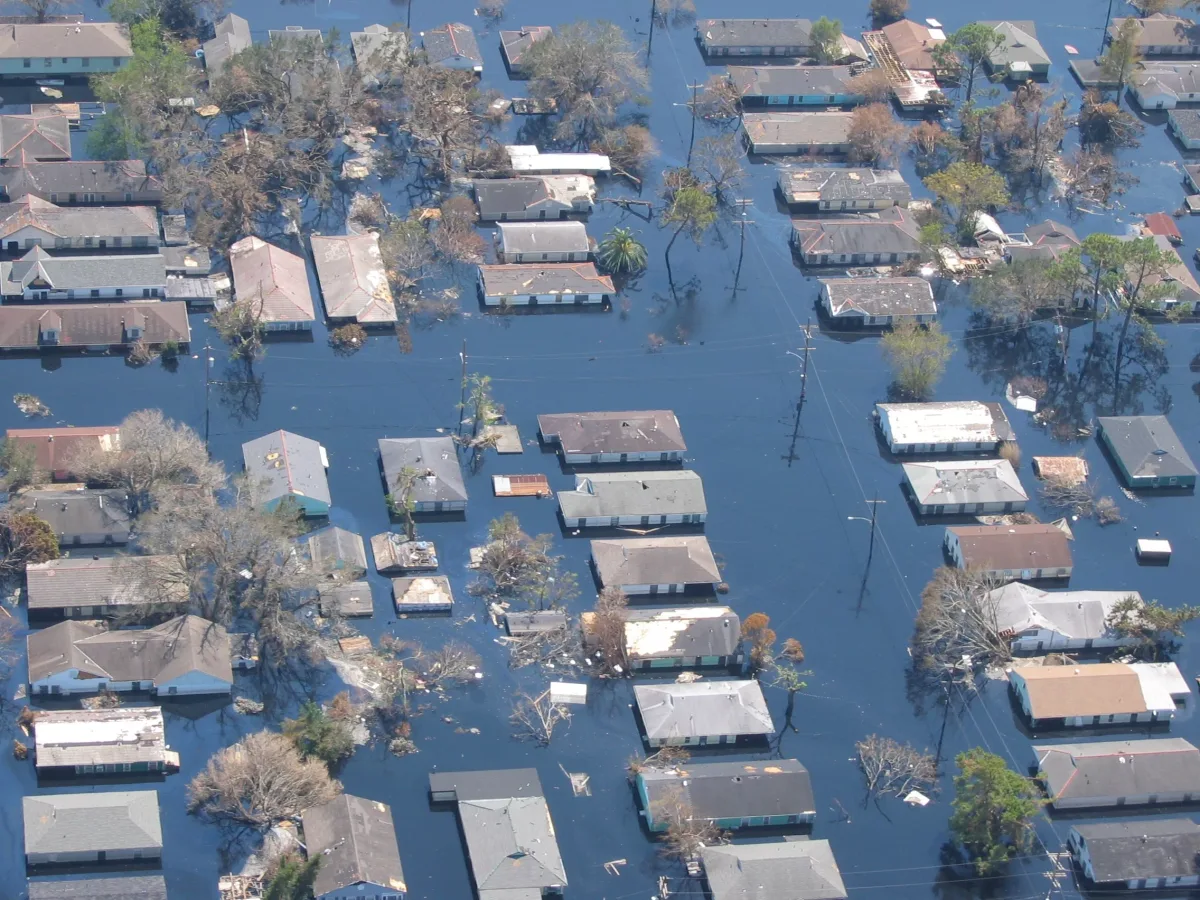
In my previous column, I examined the possibilities of Armageddon and the psychology of current apocalyptics. How fitting. I didn’t recognize anger to be entrenched in the blueprint of social collapse, but for the past week I’ve felt little else when thinking about the recent unleashing of nature’s power onto human civilization. Our objective, however, should be to put this anger aside and stop from lashing out at the incompetent little boy who is still (on paper) in charge of this country. He is an easy target, and it feels right; however, it does not advance us any closer toward understanding what is happening here. This is a crucial time, potentially more crucial than September 11th. The result of that national tragedy was predetermined as part of the Neo-Con playbook, and the horror that erupted four years ago was a tragic but convenient opening for policymakers deluded by their twin faiths in American hegemony and economic imperialism. In contrast, the result of Hurricane Katrina may have the power to wake Americans from an apathetic slumber and force us to examine who we are. If anything, the storm brings forth the idea that the shit will go down in the middle third of North America, and more importantly, that the federal state is ill-equipped, ill-prepared, and ill-motivated to help those who cannot help themselves.
Compare this with another hurricane-vulnerable nation, as reported by Marjorie Cohn, professor at Thomas Jefferson School of Law:
“Last September, a Category 5 hurricane battered the small island of Cuba with 160-mile-per-hour winds. More than 1.5 million Cubans were evacuated to higher ground ahead of the storm. Although the hurricane destroyed 20,000 houses, no one died. What is Cuban President Fidel Castro's secret? According to Dr. Nelson Valdes, a sociology professor at the University of New Mexico, and specialist in Latin America, ‘The whole civil defense is embedded in the community to begin with. People know ahead of time where they are to go…Cuba's leaders go on TV and take charge…Merely sticking people in a stadium is unthinkable’ in Cuba, Valdes said. ‘Shelters all have medical personnel from the neighborhood. They have family doctors in Cuba who evacuate together with the neighborhood, and already know, for example, who needs insulin.’”
My point is not that the United States government should be striving to be more like Castro’s. We have different systems at play, and a national system based on communal benefit at the expense of personal freedom will not work here. There are too many people with too much at stake, and this causes the mentality of the haves to be completely alienated from the realities of the have-nots (accounting for Bush’s recent series of delusional statements – example: “…out of this chaos is going to come a fantastic Gulf Coast...out of the rubbles of Trent Lott's house – the guy lost his entire house – there's going to be a fantastic house. I look forward to sitting on the porch.”). We are part of a nation that values, and has always valued, individualism over collectivism, and it is important for us to understand that alienation is not a defect in our makeup; it is an essential component. This element is illustrated not only by the hypocritical scorn the rightist corporate elite have for the “welfare state,” but also by the beauty created from iconic American artists like Thoreau and Basquiat, Kerouac and Cobain. And it is the reason Americans will individually donate record amounts of their personal income to the Red Cross but will vehemently oppose a raise in taxes necessitated by an enormous aid package to the destroyed region. Our mindset is about individual power, and this natural disaster is proof that, in this land, those without it are in thrall to the whims of those with it, especially in situations of emergency. If tragedy keeps striking, the disadvantaged will keep taking the brunt. The key question: Will we become numb? We are currently immune to poverty, homelessness, and inner-city violence. Are the images of birds devouring American bodies next? Will we grow to shrug off thousands of people chanting in unison, “HELP, HELP, HELP”? Will the third-world meet apathy when it crosses our borders?
At every catastrophe there are two paths to follow:
To the Right, we have a sustained belief in individual action and personal responsibility. This belief is reinforced by arrogant and incompetent federal policy decisions, and therefore, it is vital to the health of our national system.
To the Left, we have a newfound belief in collective responsibility and a subsequent reinvention of the American psyche. This belief would destroy all previously entrenched tradition and culture, and would therefore necessitate a community built from scratch.
Yes, I know which path we will take/are taking/already took. But I wonder how many more times this juggernaut can roll over the unfortunate before the rest of us stop giving. This is the crucial time, when the unfortunate will be forced to take serious action. If tragedies continue to devastate us, our national system will dissolve …either violently against the government if we choose the Left, or violently against the poor if we choose the Right. The last national tragedy will be the wrong choice.
Pull quote: “We are part of a nation that values, and has always valued, individualism over collectivism, and it is important for us to understand that alienation is not a defect in our makeup; it is an essential component.”
On the generation raised after The Bomb, why post-apocalyptic dreams still haunt us, and the hope that collapse could mean reorganization rather than annihilation.
Read essay ↓
All my friends have post-apocalyptic dreams. It’s a common thread that connects this age group, or at least the segment of this age group that I am drawn to have conversations with. A few of my friends have an uncanny ability to reconstruct these dreams in explicit detail, and when they get into it, we all listen respectfully. These are our ghost stories, and they come straight from this generation’s subconscious. All ghost stories are assembled from humanity’s hidden desires; however, the post-apocalyptic setting is our thing. The subject has been dealt with before (over and over again since the Book of Revelations was written), but it was resurrected with the modern age. Cinema was the most popular American art form of the 20th century, and it remains a revealing window into our collective psychology. It’s telling that as the Western waned in popularity in the second half of the last century, the post-apocalyptic narrative arrived. With the reality of the atomic bomb, humans came to understand that the end of the world isn’t likely to be handed down from a higher power. When things come crashing, it will be our own doing, and it will not be a triumphant battle fought on the hills of Meggido. This was the revelation that brought about the modern obsession with social collapse.
However, as the modern teenager grew into the modern adult, he became uninterested in the end of the world. He got a job, he invested his income, and he procreated. None of these things lend themselves to the psychology of potential apocalypse. The B movie went the way of the drive-in, and the iron curtain collapsed. The Right was vindicated, evil was destroyed, and humans were free to continue in the way of life of the Western citizen, mowing the lawn and watching television. Our parents’ reality is set firmly in tune with the stock market and their pension plans. They dream of their grandchildren coming of age in a world of luxury, and they have no reason to panic.
The Cold War is over, but my friends and I still dream of fallout. As George A. Romero prepares to deliver himself to a new generation, we are as obsessed as ever with the concept of survival in hostile terrain. The young and open-minded see this as a rational possibility, and this creates an alteration in our psyches. The era of The Bomb is over, but the peak oil crisis looms large. The fact that we are consuming more than this world can produce is apparent to most rational people, and only two possible outcomes can be drawn from this: A) Technology will save us. B) The Earth, at the end of the Sixth Major Extinction, will be pushed to its limit of radical alteration, and the human population will be drastically reduced in an apocalyptic crash of its own making. I figure the odds are close to a fifty/fifty split either way, so I prepare my future with both possibilities considered. I work 50 hours a week to pay my debts, I contribute to a 401 K, and I value stability. However, my politics and interests are fueled by the alternate potentiality. I strongly value the right of the citizen to bear arms, and I am grateful that my family retains possession of a sizable piece of land surrounded on three sides by state forest. I plan to become adept at gardening as soon as possible, and I push myself to strengthen my body and run marathons. The plan is to purchase a motorcycle and have my escape route ready. New York will be a warzone when Wall Street goes down…but I have at least fifteen years, so I’m not sweating it.
The word “apocalypse” has come to gain a negative connotation (our modern culture values power and control); however, in the Book of Revelation and in the minds of Christians it is a positive event. The word translates literally from the ancient Greek “a lifting of the veil,” and the faithful believe it will be the ultimate revelation/confirmation. And it is among the new generation of apocalypticists that the word has reverted to its ancient etymological form. Like Christians we long for the outcome of a radically reorganized planet and we doubt the sustainability of mankind’s current way of life. Add to this the romantic isolated aesthetic of the post-apocalypse, and the psychological element expressed in our recurring dreams is easily deconstructed: we all desire the supreme beauty that comes of this world’s ultimate test.
But what comes after the test? Is it annihilation, revelation, or reorganization? I believe in all of these things, but the last is the most critical to understand, especially if the higher power does not come down to show us the way. We are going to have to figure it out for ourselves with nothing but our surviving knowledge and DNA to guide us. Thankfully, these are two extremely powerful things. The opportunity to restore what we have stolen and return to the Golden Path will be made available. If we succeed, we will put our highly evolved nervous system to good use and become a positive presence in this planet’s ecosystem for the first time. If we fail, the alluring corruption of totalitarian agriculture will cover the world again. More than anything, I believe success in this venture is the divine human purpose, with or without an imminent apocalyptic catalyst. If technology comes to this culture’s rescue in time, we may have to wait millennia. If not, I will be ready.
Cover / Alarm #21, 2005 - Fall
Column scan / Alarm #21, 2005 - Fall
To Be a Human Is to Be a Thing
Alarm, Issue 20 ·
On trading daily survival for comfort, and why creation and struggle are what keep a person from withering into a thing.
Read essay ↓
“I think Bataille you really said it best, that to be a human is to be a thing.” -Spark Lights the Friction
I use public transportation daily. I’ve always dreamed of the metro life, and now I have it. I am a part of a city that swallows me up. And when I come out of my office building every day, it’s dark, and from the concourse of One New York Plaza, the lights of the downtown buildings are like a massive blanket. I pretend I could wrap myself up in them, and for about 10 seconds, until the perspective changes and I lose the angle, it feels otherworldly. I can’t believe I am a part of this construction. It’s an artificial creation, but it is also a part of nature. Manhattan is no different than the giant coral reefs. We all come from this same chemically charged mix of earth, water, and sun.
…and now I lead a glamorous life because I am finally a real part of the hoi polloi. I own a hat and a scarf and gloves. I am building my wardrobe, and I am becoming more and more a part of this world. In three days I will have medical insurance, and every day I put my time in doing paperwork in order to pay down more of my personal debt. This is the life that I live now. Once the debt is paid, I will be able to write in black, and the black ink will then be injected into my arms. And this is the only thing I wait for now…because I am happy. And all along I’ve thought happiness was the ultimate goal. I was sure every motivation came back to the pleasurable sense. But as I grow more comfortable and in control, I find myself losing some sense of my own existence. There is a part in there that is slowly going away. And I am so distracted that I hardly sense it. And I realize that people who are comfortable throughout their whole lives have never realized it was ever there.
Struggle is the natural human context. The ancestors that gave us our evolved genetic makeup lived day-to-day. Before the invention of totalitarian agriculture and before the idea of surplus, survival was a daily consideration. And that is the environment we were tailored for. Without struggle human life loses meaning. Our brains thrive off of competition; we go to our limits in order to test ourselves. We push ourselves to higher planes, because we’ve conquered this world. It is no longer a challenge. Now we seek something more, so we create concepts like sports and social mobility to be mental surrogates. This is the root of my feeling of loss. I no longer live day to day. I have a job that takes care of me like a parent, and there is nothing more to push against because nothing is pushing back.
This life is about a feeling of dissatisfaction. It’s a central theme. We are happy, but are we satisfied? It’s dangerous to confuse the two. Because as long as humans can procreate, as long as individuals can create new individuals into whom they can inject their own pearls of genetic accomplishment, there will be happiness. But satisfaction is rarely achieved. This is where the lack of meaning becomes the tangible issue: if a parent’s reason for being is solely derived from the happiness of his or her child, and that child’s reason for being is derived from the happiness of his or her child, and the cycle continues endlessly, then there is no point. The burden keeps getting passed to the next generation, and the promise is never fulfilled. This is the trick our survival instinct plays, and the point is that we need to satisfy ourselves. This is done by creating struggle, not by trying to erase it for the next generation.
I feel guilt because I no longer am in a struggle for survival, and I am afraid of heading down a path that leads to the erasure of the sense of my own importance and individuality. This is a guilt not born in the arena of politics (I work for the benefit of the Proletariat, and while I talk the talk, I still consider myself, as Bataille considered himself, “The enemy from within.”), it is born in the arena of spirituality. I am afraid of my desk and my computer screen, not because it is any kind of challenge, but because it is becoming too easy, and humans in this context have the tendency to become fat and lazy. And then, as long as they are not sincerely religious, they wonder why their life has no meaning. And what they do not understand is that we are not here to consume. We are not here to receive. We are not objects; we are subjects. We are muscles. We are machines, and like all things on this earth, if we are not put to use, we will wither and become weak. Because we are tools, and all tools have a purpose. Our purpose is survival, and our minds have mistaken the concept of survival for the portion of that concept which is ruled by procreation.
Humans are meant to create. We are meant to create more humans, but we are also meant to create many other things. Creation is often hard and frustrating work, and when the individual becomes lazy and decides that it is no longer an objective, the human ceases to become the individual. This loss is what I am scared of, and it is what keeps me writing. I do not want to forget that I am like all other things. I obey the same logical properties that this universe lays down, and the struggle for existence is not meant to be easy. Like everything else, I will eventually lose. Impermanence rules all, and this is the most important idea to struggle against. My creations will not end with the loss of my own consciousness. They will outlast me. They will eventually disappear, but even when I am gone they will have the ability to affect the Other. I know this because I am affected by the dead as they continue to exist, and there is one greater than these warriors.
Cover / Alarm #20, 2005 - Spring
Column scan / Alarm #20, 2005 - Spring
Fear the Wardulak
Alarm, Issue 19 ·
On political polarization in the 2004 election, the fear of a country under compulsion and consumption, and why this world is still worth fighting for.
Read essay ↓
Polarization. I am only 25 years old, so I am without a comprehensive perspective, but have we ever been so divided in the political process? The answer is yes (Reference: 1861-1865), but it’s to the point now where debates are for assholes. People know where they stand, and I am one of them. I stand right here…or actually over there, but in the interests of pragmatism, I stand here until November. I talk with my father, and he knows where he stands. He is one of them. I love him, and yet I cannot understand how he believes what he believes. My bond to my family is infinitely stronger than any political or philosophical affiliation, and yet I still couldn’t get the guy to see Fahrenheit 9/11 on my birthday. (I pray for the day O’Reilly, Hannity, or Coulter makes a movie. I’ll be first in line.) It’s ridiculous at this point. It’s sports, and we all have our teams we will unquestioningly root for until the day we die. I am definitely a fan. I watch Fox News and listen to Limbaugh in the interests of humor. They are like aliens. Alien invaders, their rhetoric is so foreign to my dominant paradigm. Is debate even worthwhile? Are people going to be swayed by anything? Does dialogue serve a purpose? Are we being insightful or are we being inciteful?
I am torn between the sensible temporary versus the nihilistic long-term. But I hold together. It’s a part of becoming wise: holding yourself against opposite forces. Our culture cannot last, and someday a greater species may come to our world and find a clustered layer of outrageous artifacts buried beneath the woods, but until then I will teach, and procreate, and acquiescently consume. This is the debate that rages in me. I work 15 hours, then go to the bar, consume nothing, and leave with nothing. There is no meaning to the majority of my days, and yet I question the need to keep this cycle alive. And then I drive from New York City to Syracuse, and it’s so beautiful, and I listen to Jimi Hendrix followed by Lungfish and it’s the perfect combination of temperature and sensory input, and I think that we need to keep this going at all costs. I have to tell people about this, and John Kerry has to be elected so people in other countries will stop wanting to fly planes into our buildings…because for every building there are a billion images like this.
I watched as much Democratic National Convention coverage as I could. There were few highlights. Political masturbation doesn’t speak to me. However, the pragmatic force in my brain makes me shake with anticipation for what Barack Obama could bring to this world. And everyone else feels it too. If this plays out what will the other side resort to? I’ve never been alive while a great leader performed. This could be it. He could be real hope. Not the ambiguous, impotent hope from that awful democratic slogan. Hope like Luke Skywalker.
…but I am earnestly and critically afraid of vampires. I attempt to keep myself pure while the rest of this country is slowly infected. People are taken up with a force and a lust greater than themselves. They have the thirst. Vampires are not inherently evil; they are, however, under a compulsion to devour lifeblood. This is what I’m battling against: compulsion and consumption. This is the downfall of the nation, and neither Democrat nor Republican will help on either front, and neither reactionary nor progressive has the vision to save our culture. Soon we won’t be anything more than Neanderthals. Something better will come along. We won’t notice because of our violent and self-intoxicating drama, and we will continue to break beams. No matter who is elected President of the United States of America, two thirds of the world’s population will still be starving, and there will still be hundreds of dictatorships depriving the citizens of their inalienable rights; there will still be torture; there will still be suicide, and there will still be slavery. And for this reason (the fact that I fear vampires), I do not think I have anything productive to offer to the political dialogue. When I argue and debate, people tell me I sound violent. But I am just passionate, and if my passion cannot resonate with others, then my words, which are nothing exclusive, have no chance.
And this is how I go back and forth, and when I am a public school teacher I better put it aside and have some confidence in what I am doing. I have to take a stand then. I have to communicate from a logically consistent canon. I have to prepare my students for the current world, not the world that will eventually come to exist, regardless of when I fear that eventuality might come, and I have to show them how to prolong it, to give the scientists as much time as possible to figure out how we can remain.
And that’s the difference between Andrew N. Williams and George W. Bush. We have different takes on salvation. I believe we have a lot to figure out, and he has had it figured out for him already. There is a nice plan neatly laid out: just stay thirsty, and keep it coming. Consumption is power. It drives them forward, fat on suspensors. And somehow the New Testament, which is an anti-government, anti-consumerist text, is warped, subverted, and used with devilish purpose. It is our duty, not as Americans, but as human beings to fight the subversion. I have accepted these things: 1) There is no easy answer to a complicated existence. 2) There will always be mass amounts of suffering. 3) This world is worth fighting for.