The Golden Calf of the Future
On gluttony, endless consumption, and how we worship the upgraded future instead of mastering what we already own.
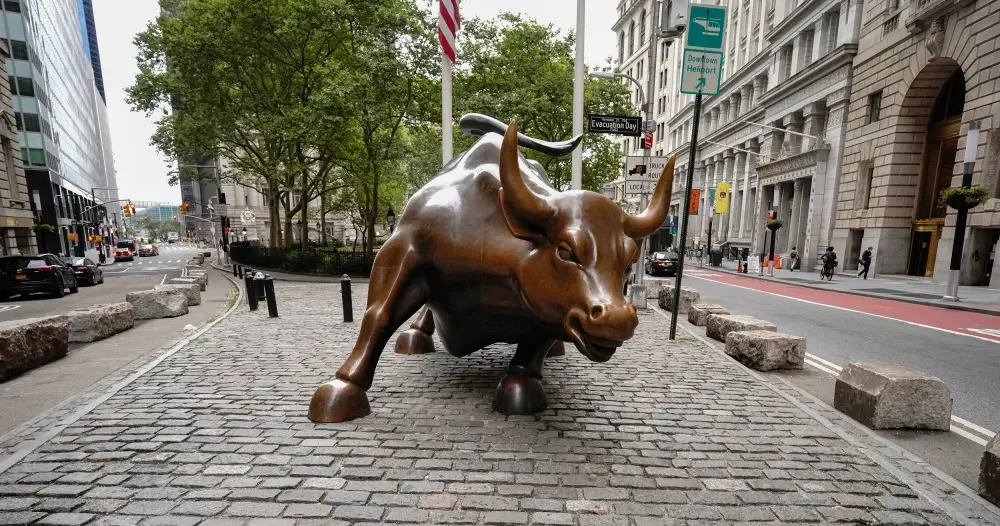
With power comes gluttony. This should be a law. It should be written into texts as an unassailable truth like every other law of science until it is proven wrong. We are a nation of fat people, and our fat is stored not only in our bodies, but in our homes, our hard drives, and in our heads.
Technical details: the health and power of our culture is based on the rate at which we consume (or more accurately, the pace at which this rate of consumption increases). The better off we are, the more things we will make, the more things we will have, and the more things we will want. This is paradoxical at the level of the individual. If power can be defined as the ability to fulfill desires, then an individual’s power can be increased by either A) increasing one’s ability or B) reducing one’s desires. The psychology necessary to make our economy strong, the psychology of credit card debt, of gadgets, of software upgrades, is a psychology that makes individuals weak. Our hypothetical desires will always be one step ahead of their real-world realizations. The glutton does not appreciate what is consumed, but only that there is more coming, that there is an endless supply. We are through worshipping Golden Calves; we have gone beyond alienating ourselves from the objects we produce. The current human worships the bigger, upgraded, to-be-released Golden Calf of the future, so now even our desires are alienated, and an imagined potential dominates our real lives.
And this problem extends beyond the tangible, as we are loaded down with more than product. Whenever I ride the train to work, I’m assaulted by newspaper hawkers. Their information is free, and I get a sense of being out of line when I decline the offer. From every angle we are pounded by information. Because it is shoved down our throats we accept it, and because we accept it, it is shoved down our throats. And this is print media. The Internet is the real albatross. The individual of the digital age has an insane ability to access information. Using Google and Wikipedia, I constantly search for and find answers to the most esoteric and trivial questions that happen to drift across my consciousness. Previously, scholars would take weeks, months, or years digging through libraries, utilizing card catalogues, and actually talking to human beings in order to collect and organize information. While these rituals are still practiced at universities, popular access to information has made the process irrelevant and quaint. We have so much coming at us, the idea of not having an answer within seconds has become unacceptable, and knowledge itself has become a cheap commodity. And still, it isn’t enough. We form communities of blogs to examine our world in even more detail. We participate in fantasy sports leagues because the games and box scores aren’t sufficient. We join social networking sites because our real-world relationships aren’t providing enough. We spend our time obtaining new interests, and we become experts in all we are interested in. We live in a world of Renaissance men.
I’ve narrowed down my necessary permanent possessions to four items: a bike, a laptop computer, a gun, and a to-be-decided tool of craft. Everything else could burn, and I would not suffer. It’s not that other objects have no value, it’s that these four items, properly employed, can give me all I need until I die. The idea isn’t that we wrongly obtain things; it is that we have forgotten how to exploit the things we obtain. Because we are consuming objects instead of utilizing them, we cheapen what we acquire, and thereby cheapen ourselves. A Roma of 19th Century Spain would spend an entire lifetime mastering the art of the Flamenco guitar without a care for processing anything else. This is the true essence of craft that the modern age has destroyed, and this is what I want back. I want to control my possessions; I want to live in this world, and I want to leave behind a worthwhile legacy as an example of what can be accomplished in 100 years.
The column as printed
Alarm #23, Summer 2006. Select a page to see it full size.